


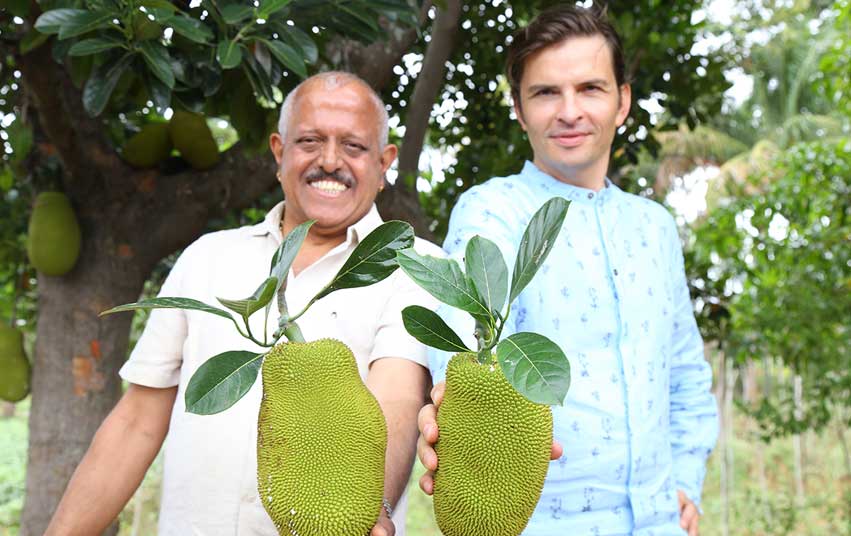
Anyone searching online for information about jackfruit as a meat substitute will inevitably come across the issue of its environmental footprint. This raises fundamental questions about whether it makes sense to use jackfruit as a meat alternative. The general view is that jackfruit only thrives in the tropics, is processed there, and therefore already has a fairly large carbon footprint by the time it reaches our shops. The massive monoculture jackfruit plantations in India or Bangladesh are also cited as a disadvantage for people and the environment.
In conversation with Hugo Lamers:
But is jackfruit as a meat substitute really such an environmental disaster as claimed? We spoke with Hugo Lamers from Bioversity International and interviewed him about the nature of jackfruit. Here is our full conversation:
Lotao: Does jackfruit as a meat substitute really perform worse than meat or soy in terms of its environmental footprint?
Hugo: I have read the articles about the low sustainability or carbon footprint of jackfruit. These articles generally do not provide substantial evidence for these claims. Compared to alternatives such as soy or meat, jackfruit should perform far better.
Lotao: How did you come to this conclusion?
When we compare jackfruit with soybeans, jackfruit has greater carbon and water efficiency. Soy is a plant and requires more water, pesticides, and fertilizer than a tree like a jackfruit tree, even when grown organically [1]. Soy is also mostly grown in distant countries such as China and Brazil.

Young jackfruit is a wonderful alternative to meat
Processing soy into tofu or chunks is many times more energy-intensive than processing jackfruit, which only needs to be cut, heated, and packaged.
Even if soy is grown in Germany in a low-carbon system, this intensive processing could lead to higher CO2 emissions than jackfruit [2].
In addition, shipping by sea is already quite efficient in terms of carbon and energy. If we one day switch to ships with electric or hybrid engines, or to much more fuel-efficient engines, this will improve even further. That is what we should focus on in the near future.
Lotao: And how would you compare the emissions from jackfruit with those from meat?
Compared to meat, jackfruit production involves far fewer CO2 emissions. Animals require a lot of feed and produce methane. Jackfruit trees produce oxygen!
The processing and transport of meat (slaughter and cold chain) are also much more carbon-intensive than jackfruit.
Conclusion: Compared to meat and soy-based meat alternatives, jackfruit has, in my opinion, far better water, energy, and carbon efficiency. But this requires research and solid evidence. As far as I know, no such study exists—and it would certainly be interesting to conduct one.
Lotao: Where do CO2 emissions mainly occur during jackfruit cultivation and production?
Hugo: Jackfruit comes from tropical countries and is processed in the country of origin, which leads to CO2 emissions. That is correct. Emissions mainly occur during jackfruit cultivation, processing (cutting, packaging, storage), transport (shipping), and consumption. However, jackfruit cultivation itself produces relatively few emissions, as jackfruit does not require much fertilizer or pest control.
Studies show that most CO2 emissions for food products occur during the cultivation of the plants, as well as by the retailer and the end consumer themselves, for example when the customer goes to the store, brings food home by car, and consumes it.
Compared to "last-mile emissions" by truck and car, even transport in large quantities by sea container is relatively less problematic than, for example, transporting food by truck from southern Italy. Air transport also has a strongly negative impact on the carbon footprint—but this is not used for jackfruit.
Lotao: What are the biggest disadvantages of monoculture jackfruit plantations in Asia?
Hugo: The claim that jackfruit is generally grown on large plantations and in monocultures is incorrect. Jackfruit originates from India, more precisely from the Western Ghats, which are considered a "biodiversity hotspot" and the origin of many spices. 95% of jackfruit is grown on field margins, in backyards, and in forests near villages.
In India, jackfruit is a "poor man's food"—every farmer has one or two trees. This is similar in Malaysia, Thailand, and Sri Lanka. Jackfruit should by no means be confused with durian plantations, which are more common in Malaysia and Thailand. The durian fruit looks similar, but has nothing to do with jackfruit. In recent years, only a few companies have emerged that grow jackfruit for export, especially in Malaysia and Thailand. However, there are only a very few large jackfruit plantations in these two countries. If such large companies were to dominate the export market one day, however, the situation would unfortunately look different again.
[1] Also compare: https://en.wikipedia.org/wiki/Perennial_plant#Benefits_in_agriculture
http://waterfootprint.org/en/water-footprint/product-water-footprint/water-footprint-crop-and-animal-products/
[2] Also compare: http://waterfootprint.org/media/downloads/Ercin-et-al-2012-WaterFootprintSoy.pdf


