


The other day, my friend Lisa asked me over dinner, "Look, I bought this sugar at the Asian shop. It's coconut blossom sugar, isn't it? Is it okay?" She then held out a greenish lump of palm sugar and waited for my expert verdict. However, it didn't taste very sweet at all, and there were reasons for that... I have been asked many questions about coconut blossom sugar in the past, such as "What is coconut blossom sugar?", "What are the quality differences in coconut blossom sugar?", and "Why is coconut blossom sugar so expensive?".
The term "coconut blossom sugar" is currently not legally protected. Formally speaking, coconut blossom sugar is unrefined "raw sugar that is obtained from the sugar sap of coconut palms". Theoretically, therefore, anything that comes from a palm blossom in any form could be called "coconut blossom sugar". Since this would not do justice to the different qualities of the sugar, two different forms tend to be distinguished in trade today - palm sugar and coconut blossom sugar.
Both forms are usually produced by farming cooperatives and are based on the nectar of the coconut palm. This is extracted from the blossom and then stirred over a fire. With palm sugar, which is sold in large chunks at the end, the stirring process only takes a short time. After boiling, the sap is poured into vessels and then dried. Especially in Asian countries, this drying process leads to contamination.
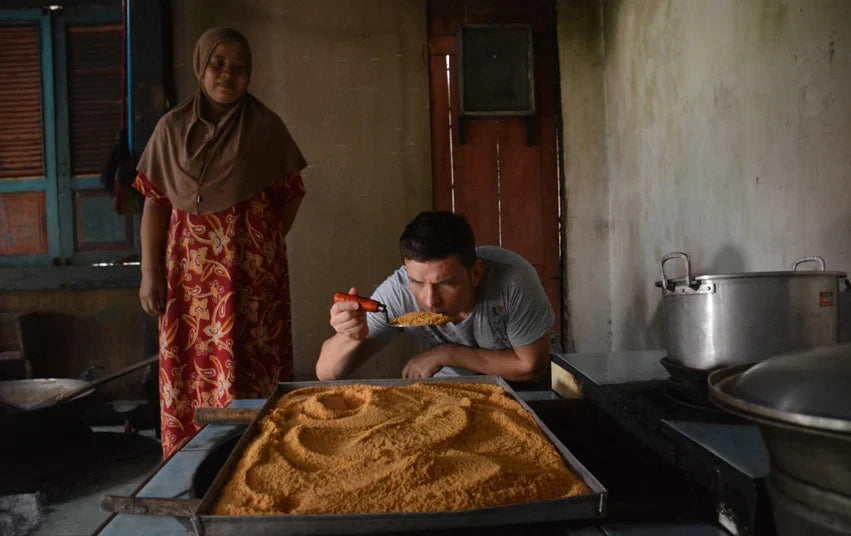
Some cooperatives – especially manufacturers of non-organic products – additionally add sodium sulfite to the sap. This accelerates the drying process, but is not conducive to the health of the consumer. Unfortunately, the chemical aid is often not declared, which is why you should either stay away from cheap "lump goods" or check yourself: A greenish color of the sugar or a slightly fishy smell are clear indications of contamination with sodium sulfite. When making coconut blossom sugar, the nectar is stirred over the fire for longer, until the mass is almost dry.
This process takes over four hours and yields at most one to two kilograms of the "sweet gold". Afterwards, the sugar is ground with coconut shells, sifted, and dried again. It is obvious that this intensive extra work is also paid accordingly and that coconut blossom sugar is therefore more expensive. Unfortunately, there are also some black sheep among the manufacturers of coconut blossom sugar: It is relatively easy to mix cheap brown cane sugar into the nectar in the cauldron.
The industrial sugar dissolves in the nectar, the coconut nectar-cane sugar mixture is boiled, stirred, and dried. In the end, the mixture is barely noticeable to the naked eye – however, the producer receives twice the amount of sugar for the same amount of work and thus double the sales revenue. The consumer is deceived and pays a very high price for the cheap coconut-industrial sugar mixture.
But how can you defend yourself against this? A first indication of mixed sugar quality is solubility: Pure coconut blossom sugar is generally more soluble than brown cane sugar – which is why it is so popular in combination with chocolates, sauces, juices, or marinades. If your coconut blossom sugar suddenly dissolves less well in liquids than before, this could indicate mixing. In this case, you should contact the manufacturer and ask.
A responsible importer usually has good and long-term contact with their farming cooperative, but can also provide an isotope analysis for every sugar delivery. This examines the carbons of the sugar molecules. If the sugar sample contains different types of carbon, this is a clear indication of mixing different types of sugar. If a producer cannot provide this analysis, or important questions remain unanswered, you should change the manufacturer. In addition to a high degree of purity, the drying process is also an important quality criterion. Coconut blossom sugar must have a fine, caramel aroma and melt on the tongue. If it tastes slightly burnt, it was dried for too long or incorrectly. If it feels damp, it was not dried enough or was stored incorrectly. Any moisture content greater than 3% is a reason for a complaint. Here too, the manufacturer should be able to provide corresponding analyses. The formation of small lumps or the color of the sugar generally do not represent quality criteria – since the sugar is a pure natural product, there can always be natural fluctuations in grain size and color.
But nature is diverse, and why should it be different with palms? There are dozens of different palm species, which accordingly provide different "sugar saps". For coconut blossom sugar production, the blossoms of Kelapa palms and Arenga palms are currently particularly used. Arenga sugar is usually cheaper because there are more Arenga palms in the production areas, the blossoms are more easily accessible, and therefore production is cheaper. The production of Kelapa sugar, on the other hand, is more labor-intensive – this sugar is also more delicately melting and rarer. However, the connection between the "palm species" and the "sugar quality" is hardly researched. To avoid buying the cheap Arenga quality at an inflated price, you should nevertheless make sure that the manufacturer states the palm species on their website or on the packaging. This brings me to the last quality aspect, the packaging: Coconut blossom sugar is hygroscopic, i.e., it very quickly absorbs air moisture and thus also odors from the outside.
Therefore, you should definitely buy and store coconut blossom sugar in a resealable package – in a glass or in a jar. For sugar from a paper bag, it is recommended to check whether it was also airtightly sealed. You should also transfer this sugar into another sealable container as quickly as possible after opening.
In summary, here are the most important criteria for good coconut blossom sugar again:
- Coconut blossom sugar from the Kelapa palm
- Light or dark brownish color
- Fine caramel aroma
- Pure quality (if applicable, Iso-proof!)
- Maximum 3% moisture
This should NOT apply to your coconut blossom sugar as much as possible:
- Slightly greenish color (indication of sodium sulfite addition)
- Slight fish smell (indication of sodium sulfite addition)
- Burnt aroma (indication of incorrect drying process)
- Poor solubility (indication of mixing with other sugar varieties)
- Non-resealable packaging (absorption of foreign odors)
- Open storage
After I had listed all this to Lisa, she no longer found her palm sugar piece from the Asian shop so great. Maybe next time I should bring a jar of coconut blossom sugar from biozentrale with the meal instead of flowers. And a little "hidden product placement" can't hurt - as every James Bond film teaches us again and again ;)


