


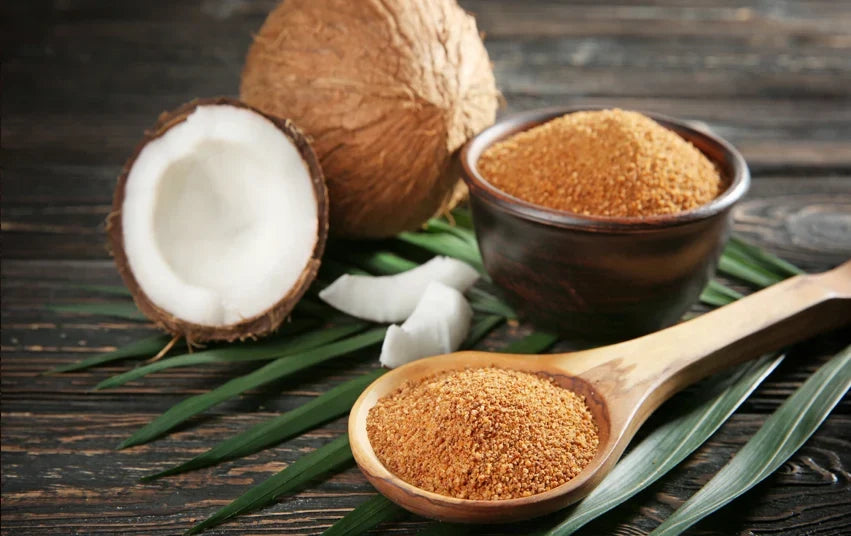
As many questions about coconut blossom sugar keep cropping up, we would like to offer a few tips on this exciting type of sugar today.
Those who read this cheerful question-and-answer game to the end will be rewarded with a particularly great recipe:
Pumpkin Spiced Latte, a very creative recipe creation by Kristin, product manager at the vegan supermarket chain Veganz. Kristin found this recipe in New York, where Pumpkin Spiced Latte has now become an absolute trend drink. But first, here is the ABC of coconut blossom sugar:
What is the difference compared to palm sugar from the Asian shop?
Classic palm sugar is often mixed with brown sugar or sugar from various palm trees. With cheap "palm sugar blocks," the nectar is not stirred over a fire, but dried in containers for hours. This usually leads to contamination. Some suppliers also mix this sugar with sodium sulfite to speed up the drying process. Sodium sulfite additives can be identified by the green shimmer of the sugar as well as a slightly fishy smell (Warning - carcinogenic).
Does coconut blossom sugar taste like coconut?
Although the name "coconut blossom sugar" would actually suggest it, biozentrale coconut blossom sugar does not taste like coconut at all. Coconut blossom sugar has a delicately sweet taste with a light caramel aroma. It literally melts on the tongue and then surprises with a very light vanilla-malt note.
What makes coconut blossom sugar so special? What can it be used for?
The sugar has several properties that make it so excellent for the kitchen:
Coconut blossom sugar has a low melting point - it melts immediately in the mouth or in cold liquids.
It is therefore very suitable, for example, for dark cocktails (e.g. with rum). Due to the dark discoloration, the sugar should not be used for light, clear cocktails. It is also excellent for marinades, for sweetening teas and for all chocolate desserts.
Coconut blossom sugar has a low glycemic index (GI). The GI is 32, and thus half as high as regular sugar – i.e. the sugar enters the blood slowly and is therefore suitable for all people who have a problem with sugar. Coconut blossom sugar adds structure to baked goods. Unlike stevia or maple syrup, it is very suitable for baking because it supports the shape of the baked goods. It can be used 1:1 as a substitute for regular sugar.
Coconut blossom sugar enhances the natural aroma. When fried dishes, it also gives a fine shine and rounds off every sauce deliciously.
Compared to other types of sugar, coconut blossom sugar is harvested very gently – i.e. it is rich in nutrients and is therefore particularly popular in health-conscious kitchens.
If you would now like to try the sugar where it belongs, namely in the kitchen, the following trend recipe from Kristen at Veganz is recommended:
What ingredients does coconut blossom sugar contain?
The exact composition of the sugar is certainly not just an exciting topic for chemists, because the analysis data proves how nutrient-rich coconut blossom sugar actually is. 100 g of coconut blossom sugar contains:
- 378.9 calories
- 0.01 g protein
- 0.01 g fat
- 1.5 mg calcium
- 0.2 mg magnesium
- 0.2 mg potassium
- 94.15 g sucrose
- 1.55 g glucose
- 1.68 g fructose
- 2.52 % moisture content
What spice-sugar varieties are available at Lotao?
In addition to biozentrale coconut blossom sugar, Biozentrale also offers other types of sugar, such as agave thick syrup for a fine sweetness..

Simple and wonderful: Pumpkin Spiced Latte
Pumpkin Spiced Latte
Ingredients:
- 2 tbsp pumpkin puree (e.g. from cooked Hokkaido pumpkin)
- 3 tbsp biozentrale coconut blossom sugar
- 1 pinch cinnamon
- 1 pinch cardamom
- 240 ml. soy milk
- 2 espressos
Preparation:
- Mix the pumpkin puree with biozentrale coconut blossom sugar and the spices, then pour over hot frothed soy milk.
- Pour a double espresso over it and enjoy hot! Perfect for the autumn season!


